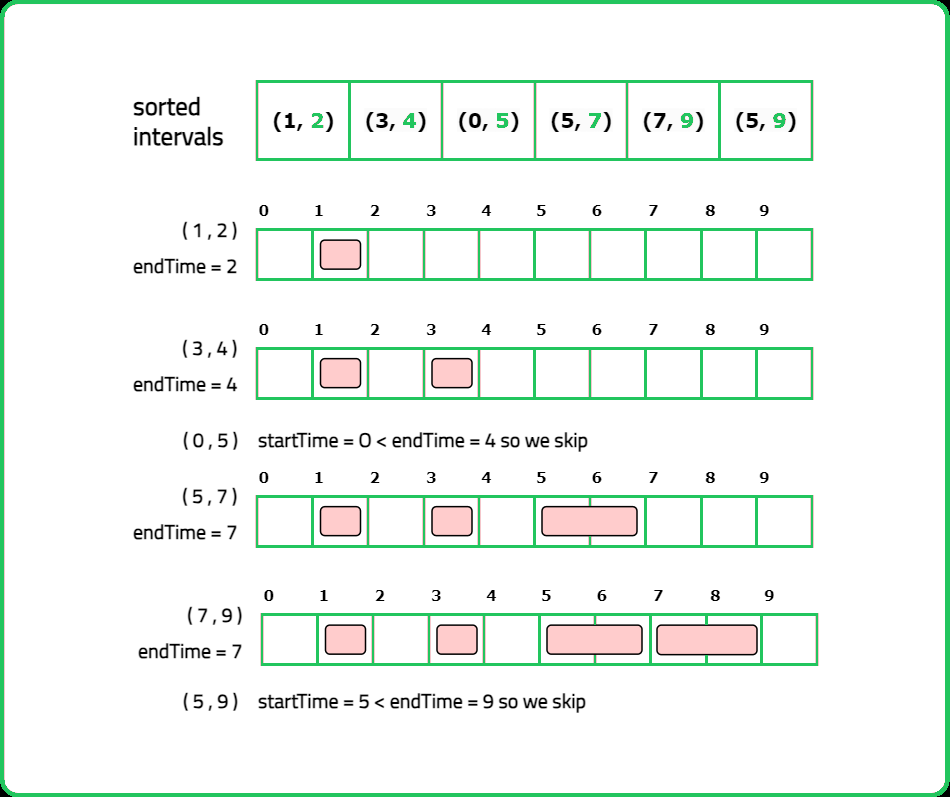
Given an array of N intervals in the form of (start[i], end[i]), where start[i] is the starting point of the interval and end[i] is the ending point of the interval, return the minimum number of intervals that need to be removed to make the remaining intervals non-overlapping.
Input : Intervals = [ [1, 2] , [2, 3] , [3, 4] ,[1, 3] ]
Output : 1
Explanation : You can remove the interval [1, 3] to make the remaining interval non overlapping.
Input : Intervals = [ [1, 3] , [1, 4] , [3, 5] , [3, 4] , [4, 5] ]
Output : 2
Explanation : You can remove the intervals [1, 4] and [3, 5] and the remaining intervals becomes non overlapping.
Input : Intervals = [ [1, 10] , [1, 4] , [3, 8] , [3, 4] , [4, 5] ]
#include <bits/stdc++.h>
using namespace std;
class Solution {
private:
// Comparator function to compare intervals based on their ending times
bool static comp(vector<int>& val1, vector<int>& val2) {
return val1[1] < val2[1];
}
public:
// Function to count the maximum number of non-overlapping intervals
int MaximumNonOverlappingIntervals(vector<vector<int>>& intervals) {
// Sort the intervals based on their ending times
sort(intervals.begin(), intervals.end(), comp);
// Get total number of intervals
int n = intervals.size();
// Initialize counter
int cnt = 1;
// Keep track of the ending time
int lastEndTime = intervals[0][1];
// Iterate through all intervals
for (int i = 1; i < n; i++) {
/* Check if the starting time of the current
interval is greater than or equal to
the ending time of the last
selected interval */
if (intervals[i][0] >= lastEndTime) {
// Increment counter
cnt++;
// Update the ending time
lastEndTime = intervals[i][1];
}
}
return n - cnt;
}
};
// Main function
int main() {
vector<vector<int>> intervals = {{0, 5}, {3, 4}, {1, 2}, {5, 9}, {7, 9}};
// Creating an object of solution class
Solution solution;
// Function call to get the maximum non-overlapping intervals
int ans = solution.MaximumNonOverlappingIntervals(intervals);
cout << "Maximum Non-Overlapping Intervals: " << ans << endl;
return 0;
}
import java.util.*;
class Solution {
// Comparator function to compare intervals based on their ending times
public static int comp(int[] val1, int[] val2) {
// Compare the ending times of the intervals
return Integer.compare(val1[1], val2[1]);
}
// Function to count the maximum number of non-overlapping intervals
public int MaximumNonOverlappingIntervals(int[][] intervals) {
// Sort the intervals based on their ending times
Arrays.sort(intervals, Solution::comp);
// Get total number of intervals
int n = intervals.length;
// Initialize counter
int cnt = 1;
// Keep track of the ending time
int lastEndTime = intervals[0][1];
// Iterate through all intervals
for (int i = 1; i < n; i++) {
/* Check if the starting time of the current
interval is greater than or equal to
the ending time of the last
selected interval */
if (intervals[i][0] >= lastEndTime) {
// Increment counter
cnt++;
// Update the ending time
lastEndTime = intervals[i][1];
}
}
return n-cnt;
}
}
// Main class
class Main {
public static void main(String[] args) {
Solution obj = new Solution();
int[][] intervals = {{0, 5}, {3, 4}, {1, 2}, {5, 9}, {7, 9}};
for (int i = 0; i < intervals.length; i++) {
System.out.println("Interval " + (i + 1) + " Start: " + intervals[i][0] + " End: " + intervals[i][1]);
}
int ans = obj.MaximumNonOverlappingIntervals(intervals);
System.out.println("Maximum Non-Overlapping Intervals: " + ans);
}
}class Solution:
# Function to compare intervals based on ending times
@staticmethod
def comp(val1, val2):
# Compare the ending times of the intervals
return val1[1] < val2[1]
# Function to count the maximum number of non-overlapping intervals
def MaximumNonOverlappingIntervals(self, intervals):
# Sort the intervals based on their ending times
intervals.sort(key=lambda x: x[1])
# Get total number of intervals
n = len(intervals)
# Initialize counter
cnt = 1
# Keep track of the ending time
last_end_time = intervals[0][1]
# Iterate through all intervals
for i in range(1, n):
# Check if the starting time of the current
# interval is greater than or equal to the
# ending time of the last selected interval
if intervals[i][0] >= last_end_time:
# Increment counter
cnt += 1
# Update the ending time
last_end_time = intervals[i][1]
return n-cnt
# Example usage
if __name__ == "__main__":
obj = Solution()
intervals = [[0, 5], [3, 4], [1, 2], [5, 9], [7, 9]]
for i, interval in enumerate(intervals):
print(f"Interval {i + 1} Start: {interval[0]} End: {interval[1]}")
ans = obj.MaximumNonOverlappingIntervals(intervals)
print(f"Maximum Non-Overlapping Intervals: {ans}")
class Solution {
// Comparator function to compare intervals based on their ending times
static comp(a, b) {
// Compare the ending times of the intervals
return a[1] - b[1];
}
// Function to count the maximum number of non-overlapping intervals
MaximumNonOverlappingIntervals(intervals) {
// Sort the intervals based on their ending times
intervals.sort(Solution.comp);
// Get total number of intervals
const n = intervals.length;
// Initialize counter
let cnt = 1;
// Keep track of the ending time
let lastEndTime = intervals[0][1];
// Iterate through all intervals
for (let i = 1; i < n; i++) {
/* Check if the starting time of
the current interval is greater
than or equal to the ending time of
the last selected interval */
if (intervals[i][0] >= lastEndTime) {
// Increment counter
cnt++;
// Update the ending time
lastEndTime = intervals[i][1];
}
}
return n-cnt;
}
}
// Example usage
const obj = new Solution();
const intervals = [[0, 5], [3, 4], [1, 2], [5, 9], [7, 9]];
intervals.forEach((interval, i) => {
console.log(`Interval ${i + 1} Start: ${interval[0]} End: ${interval[1]}`);
});
const ans = obj.MaximumNonOverlappingIntervals(intervals);
console.log(`Maximum Non-Overlapping Intervals: ${ans}`);
Q: Why sort by end time instead of start time?
A: Sorting by end time ensures that you select the interval that leaves the most space for subsequent intervals, maximizing the number of non-overlapping intervals that can be included.
Q: What if two intervals have the same end time?
A: If two intervals share the same end time, their order doesn’t matter because overlapping will still be avoided by comparing the start times.
Q: How would you handle dynamic updates to the intervals?
A: For dynamic scenarios, such as adding or removing intervals, consider using a balanced binary search tree or interval tree to efficiently manage overlapping intervals.
Q: What if you wanted to minimize the total "overlap time" instead of removing intervals?
A: Modify the algorithm to calculate and minimize the sum of overlapping durations rather than the count of intervals removed.
Your notes are automatically saved in your browser's local storage and will persist across sessions on this device.