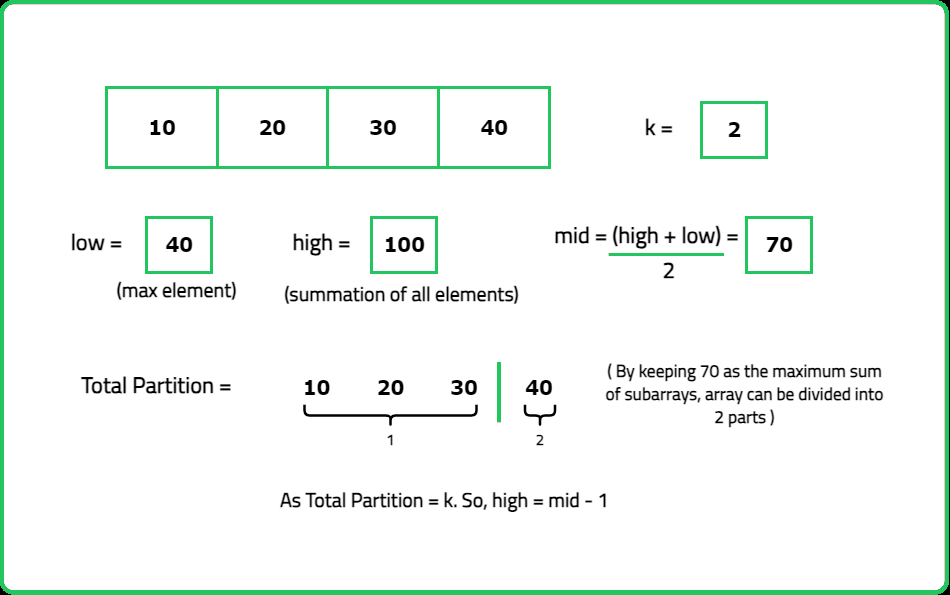
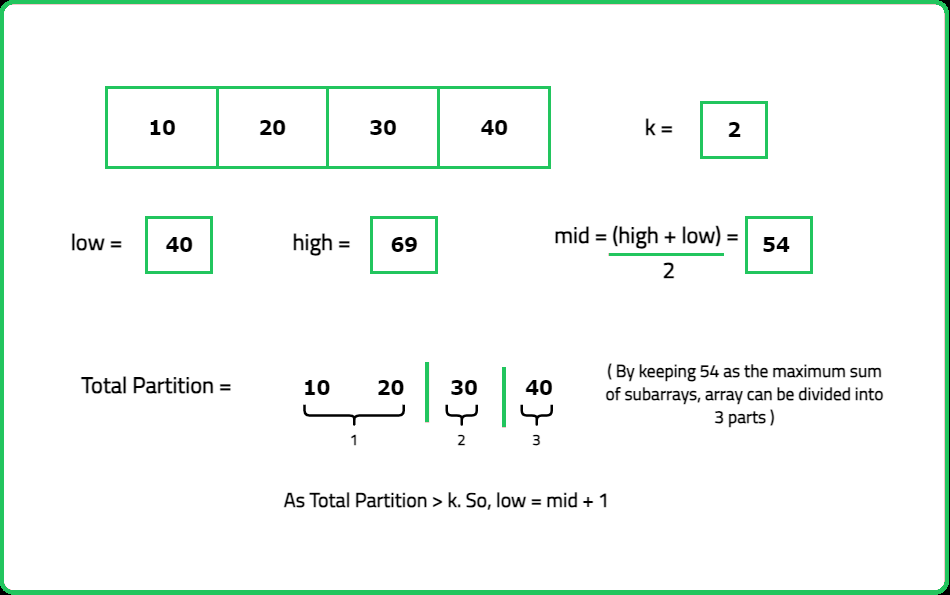
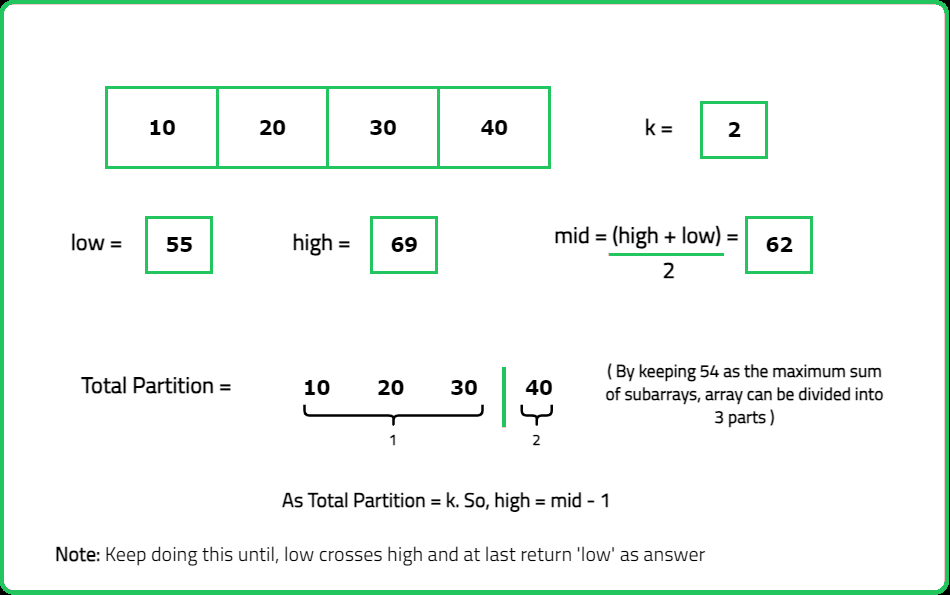
Given an integer array a of size n and an integer k. Split the array a into k non-empty subarrays such that the largest sum of any subarray is minimized. Return the minimized largest sum of the split.
Input: a = [1, 2, 3, 4, 5], k = 3
Output:6
Explanation: There are many ways to split the array a[] into k consecutive subarrays. The best way to do this is to split the array a[] into [1, 2, 3], [4], and [5], where the largest sum among the three subarrays is only 6.
Input: a = [3,5,1], k = 3
Output: 5
Explanation: There is only one way to split the array a[] into 3 subarrays, i.e., [3], [5], and [1]. The largest sum among these subarrays is 5.
Input: a = [1, 2, 3, 4, 5], k = 2
low and high: Initially, low will point to maximum element of the array and high will point to the sum of all the elements of the array.mid using the following formula: mid = (low+high) // 2 ( ‘//’ refers to integer division).


#include <bits/stdc++.h>
using namespace std;
class Solution {
private:
/* Function to count partitions such
that each partition has sum <= maxSum*/
int countPartitions(vector<int> &a, int maxSum) {
int n = a.size();
int partitions = 1;
long long subarraySum = 0;
for (int i = 0; i < n; i++) {
if (subarraySum + a[i] <= maxSum) {
// Add element to the current subarray
subarraySum += a[i];
} else {
// Start a new subarray with current element
partitions++;
subarraySum = a[i];
}
}
return partitions;
}
public:
/* Function to find the largest minimum
subarray sum with at most k partitions*/
int largestSubarraySumMinimized(vector<int> &a, int k) {
// Initialize binary search boundaries
int low = *max_element(a.begin(), a.end());
int high = accumulate(a.begin(), a.end(), 0);
// Apply binary search
while (low <= high) {
int mid = (low + high) / 2;
int partitions = countPartitions(a, mid);
if (partitions > k) {
/*If partitions exceed k, increase
the minimum possible subarray sum*/
low = mid + 1;
}
else {
/*If partitions are within k, try to
minimize the subarray sum further*/
high = mid - 1;
}
}
/* After binary search, 'low' will
be the largest minimum subarray sum
with at most k partitions*/
return low;
}
};
int main() {
vector<int> a = {10, 20, 30, 40};
int k = 2;
// Create an instance of the Solution class
Solution sol;
int ans = sol.largestSubarraySumMinimized(a, k);
cout << "The answer is: " << ans << "\n";
return 0;
}
import java.util.*;
class Solution {
/* Function to count partitions such
that each partition has sum <= maxSum*/
private int countPartitions(int[] a, int maxSum) {
int n = a.length;
int partitions = 1;
long subarraySum = 0;
for (int i = 0; i < n; i++) {
if (subarraySum + a[i] <= maxSum) {
// Add element to the current subarray
subarraySum += a[i];
} else {
// Start a new subarray with current element
partitions++;
subarraySum = a[i];
}
}
return partitions;
}
/* Function to find the largest minimum
subarray sum with at most k partitions*/
public int largestSubarraySumMinimized(int[] a, int k) {
// Initialize binary search boundaries
int low = a[0];
int high = 0;
//Find maximum and summation
for (int i = 0; i < a.length; i++) {
low = Math.max(low, a[i]);
high += a[i];
}
// Apply binary search
while (low <= high) {
int mid = (low + high) / 2;
int partitions = countPartitions(a, mid);
if (partitions > k) {
/* If partitions exceed k, increase
the minimum possible subarray sum*/
low = mid + 1;
}
else {
/* If partitions are within k, try to
minimize the subarray sum further*/
high = mid - 1;
}
}
/* After binary search, 'low' will
be the largest minimum subarray sum
with at most k partitions*/
return low;
}
public static void main(String[] args) {
int[] a = {10, 20, 30, 40};
int k = 2;
// Create an instance of the Solution class
Solution sol = new Solution();
int ans = sol.largestSubarraySumMinimized(a, k);
// Print the answer
System.out.println("The answer is: " + ans);
}
}
class Solution:
""" Function to count partitions such
that each partition has sum <= maxSum"""
def countPartitions(self, a, maxSum):
n = len(a)
partitions = 1
subarraySum = 0
for i in range(n):
if subarraySum + a[i] <= maxSum:
# Add element to the current subarray
subarraySum += a[i]
else:
# Start a new subarray with current element
partitions += 1
subarraySum = a[i]
return partitions
""" Function to find the largest minimum
subarray sum with at most k partitions"""
def largestSubarraySumMinimized(self, a, k):
# Initialize binary search boundaries
low = max(a)
high = sum(a)
# Apply binary search
while low <= high:
mid = (low + high) // 2
partitions = self.countPartitions(a, mid)
if partitions > k:
""" If partitions exceed k, increase
the minimum possible subarray sum"""
low = mid + 1
else:
""" If partitions are within k, try to
minimize the subarray sum further"""
high = mid - 1
""" After binary search, 'low' will be
the largest minimum subarray sum with
at most k partitions"""
return low
if __name__ == "__main__":
a = [10, 20, 30, 40]
k = 2
# Create an instance of the Solution class
sol = Solution()
# Print the answer
print("The answer is:", sol.largestSubarraySumMinimized(a, k))
class Solution {
/* Function to count partitions such
that each partition has sum <= maxSum*/
countPartitions(a, maxSum) {
let n = a.length;
let partitions = 1;
let subarraySum = 0;
for (let i = 0; i < n; i++) {
if (subarraySum + a[i] <= maxSum) {
// Add element to the current subarray
subarraySum += a[i];
} else {
// Start a new subarray with current element
partitions++;
subarraySum = a[i];
}
}
return partitions;
}
/* Function to find the largest minimum
subarray sum with at most k partitions*/
largestSubarraySumMinimized(a, k) {
// Initialize binary search boundaries
let low = Math.max(...a);
let high = a.reduce((acc, curr) => acc + curr, 0);
// Apply binary search
while (low <= high) {
let mid = Math.floor((low + high) / 2);
let partitions = this.countPartitions(a, mid);
if (partitions > k) {
/* If partitions exceed k, increase
the minimum possible subarray sum*/
low = mid + 1;
} else {
/* If partitions are within k, try to
minimize the subarray sum further*/
high = mid - 1;
}
}
/* After binary search, 'low' will be
the largest minimum subarray sum with
at most k partitions*/
return low;
}
}
const a = [10, 20, 30, 40];
const k = 2;
//Create an instance of Solution class
const sol = new Solution();
// Print the answer
console.log("The answer is:", sol.largestSubarraySumMinimized(a, k));
Q: Why use binary search to minimize the largest sum?
A: Testing all possible splits is computationally expensive (O(2^n)). Binary search narrows the range of possible sums, reducing the complexity to O(n⋅log(sum(a)−max(a))).
Q: How is the feasibility of mid checked?
A: Traverse the array and form subarrays: Add elements to the current subarray until adding another element would exceed mid. Start a new subarray and increment the subarray count. If the subarray count exceeds k, mid is not feasible.
Q: Can this approach handle dynamic updates to the array?
A: For dynamic scenarios, maintain a prefix sum array to quickly recompute sums. Apply the binary search logic on the updated prefix sum.
Q: How would you handle additional constraints, like maximum subarray length?
A: Modify the feasibility check to account for the maximum allowed subarray length. Ensure that the number of elements in each subarray does not exceed the constraint during the traversal.
Your notes are automatically saved in your browser's local storage and will persist across sessions on this device.