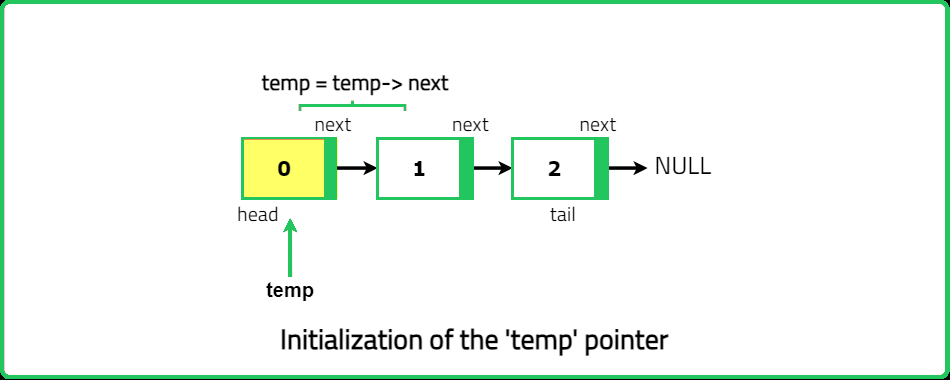
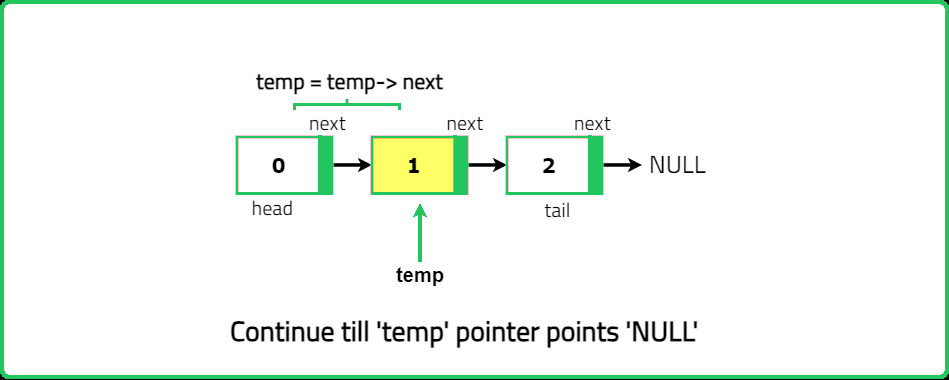
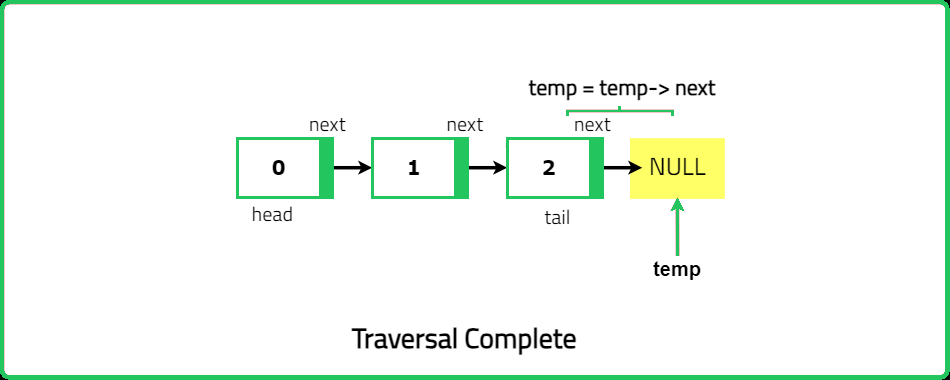
Given the head of a singly Linked List. Traverse the entire Linked List and return its elements in an array in the order of their appearance.
Input: head -> 5 -> 4 -> 3 -> 1 -> 0
Output: [5, 4, 3, 1, 0]
Explanation: The nodes in the Linked List are 5 -> 4 -> 3 -> 1 -> 0, with the head pointing to node with value 5.
Input: head -> 1
Output: [1]
Explanation: Only one node present in the list.
Input: head -> 0 -> 2 -> 5


#include <bits/stdc++.h>
using namespace std;
struct ListNode {
int val;
ListNode* next;
ListNode(int data1) : val(data1), next(nullptr) {}
ListNode(int data1, ListNode* next1) : val(data1), next(next1) {}
};
class Solution {
public:
//Function for Linked List Traversal
vector<int> LLTraversal(ListNode* head) {
//Storing a copy of the linked list
ListNode* temp = head;
//To store the values
//Sequentially
vector<int> ans;
//Keep traversing
//Until the nullptr
//Is not encountered
while (temp != nullptr) {
//Storing of the values
ans.push_back(temp->val);
//Storing the address of the next node
temp = temp->next;
}
//Return answer
return ans;
}
};
int main() {
//Manual creation of nodes
ListNode* y1 = new ListNode(2);
ListNode* y2 = new ListNode(5);
ListNode* y3 = new ListNode(8);
ListNode* y4 = new ListNode(7);
// Linking the nodes
y1->next = y2;
y2->next = y3;
y3->next = y4;
//Instance of
//Solution class
Solution sol;
//Calling LLTraversal method
//To get the values
vector<int> result = sol.LLTraversal(y1);
//Printing the result
cout << "Linked List Values:" << endl;
for (int val : result) {
cout << val << " ";
}
cout << endl;
//Clean up
//Allocated memory
delete y1;
delete y2;
delete y3;
delete y4;
return 0;
}
import java.io.*;
class ListNode {
int val;
ListNode next;
ListNode(int data1) {
val = data1;
next = null;
}
ListNode(int data1, ListNode next1) {
val = data1;
next = next1;
}
}
class Solution {
//Function for Linked List Traversal
public List<Integer> LLTraversal(ListNode head) {
//Storing a copy of the linked list
ListNode temp = head;
//To store the values sequentially
List<Integer> ans = new ArrayList<>();
//Keep traversing
//Until null is encountered
while (temp != null) {
//Storing the values
ans.add(temp.val);
//Storing the address of the next node
temp = temp.next;
}
//Return answer
return ans;
}
}
public class Main {
public static void main(String[] args) {
//Manual creation of nodes
ListNode y1 = new ListNode(2);
ListNode y2 = new ListNode(5);
ListNode y3 = new ListNode(8);
ListNode y4 = new ListNode(7);
// Linking the nodes
y1.next = y2;
y2.next = y3;
y3.next = y4;
// Creating an instance of
//Solution class
Solution solution = new Solution();
// Calling LLTraversal method
//To get the values
List<Integer> result = solution.LLTraversal(y1);
// Printing the result
System.out.println("Linked List Values:");
for (int val : result) {
System.out.print(val + " ");
}
System.out.println();
}
}
class ListNode:
def __init__(self, val=0, next=None):
self.val = val
self.next = next
class Solution:
# Function for Linked List Traversal
def LLTraversal(self, head: ListNode) -> list:
# Storing a copy
#Of the linked list
temp = head
#To store
#Values sequentially
ans = []
#Keep traversing
#Until the None
#Is not encountered
while temp is not None:
#Storing of the values
ans.append(temp.val)
#Storing the address
#Of the next node
temp = temp.next
#Returning the answer
return ans
if __name__ == "__main__":
#Manual creation of nodes
y1 = ListNode(2)
y2 = ListNode(5)
y3 = ListNode(8)
y4 = ListNode(7)
#Linking the nodes
y1.next = y2
y2.next = y3
y3.next = y4
#Solution class
sol = Solution()
#Calling LLTraversal method
result = sol.LLTraversal(y1)
#Printing the result
print("Linked List Values:")
for val in result:
print(val, end=" ")
print()
class ListNode {
constructor(val = 0, next = null) {
this.val = val;
this.next = next;
}
}
class Solution {
//Function for
//Linked List Traversal
LLTraversal(head) {
//Storing a copy
//Of the linked list
let temp = head;
//To store the
//Values sequentially
let ans = [];
//Keep traversing
//Until the null is
//Not encountered
while (temp !== null) {
// Storing of the values
ans.push(temp.val);
//Storing the address
//Of the next node
temp = temp.next;
}
//Return answer
return ans;
}
}
//Manual creation of nodes
let y1 = new ListNode(2);
let y2 = new ListNode(5);
let y3 = new ListNode(8);
let y4 = new ListNode(7);
//Linking the nodes
y1.next = y2;
y2.next = y3;
y3.next = y4;
//Solution instance
let sol = new Solution();
// Calling LLTraversal method to get the values
let result = sol.LLTraversal(y1);
// Printing the result
console.log("Linked List Values:");
for (let val of result) {
console.log(val + " ");
}
Q: How do you handle very large linked lists?
A: The iterative approach is preferred for large lists because it avoids the stack overflow risk associated with recursion.
Q: How do you confirm the traversal order?
A: The traversal order is guaranteed to be the same as the linked list order because each node is processed sequentially.
Q: What if you need to reverse the traversal order?
A: Use a stack to store the values during traversal and pop elements from the stack to get them in reverse order. Alternatively, reverse the array after traversal.
Q: Can this algorithm be parallelized?
A: Traversing a singly linked list cannot be parallelized because each node depends on the next pointer of the previous node. However, parallelization is possible for tasks performed on the data after traversal.
Your notes are automatically saved in your browser's local storage and will persist across sessions on this device.