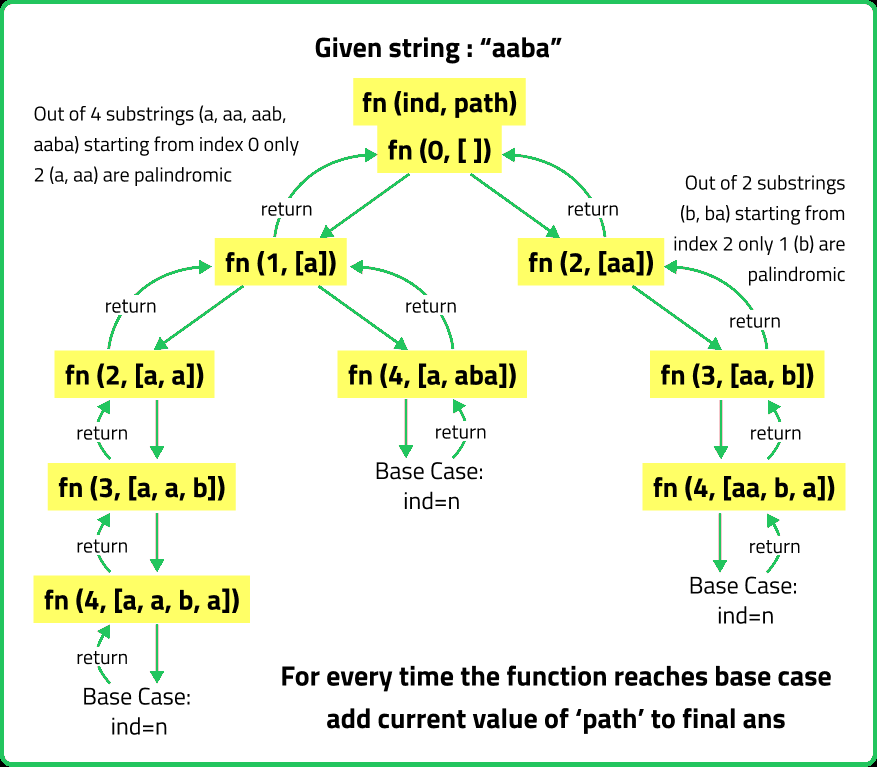
Given a string s partition string s such that every substring of partition is palindrome. Return all possible palindrome partition of string s.
Input : s = "aabaa"
Output : [ [ "a", "a", "b", "a", "a"] , [ "a", "a", "b", "aa"] , [ "a", "aba", "a"] , [ "aa", "b", "a", "a"] , [ "aa", "b", "aa" ] , [ "aabaa" ] ]
Explanation : Above all are the possible ways in which the string can be partitioned so that each substring is a palindrome.
Input : s = "baa"
Output : [ [ "b", "a", "a"] , [ "b", "aa" ] ]
Explanation : Above all are the possible ways in which the string can be partitioned so that each substring is a palindrome.
Input : s = "ab"
Imagine organizing a long sentence into meaningful phrases. Start at the beginning, find a segment that forms a meaningful phrase, and write it down. Move to the next segment and repeat the process. If reaching the end of the sentence and having a list of meaningful phrases, the job is done. If stuck, erase the last phrase, try a different segment, and continue until all segments are explored and every possible meaningful combination is found.
The process involves breaking down a problem into smaller sub-problems. Begin at the start of a string and identify palindromic substrings. Record a substring and proceed to the next part of the string. Continue this process until the end of the string. If the end is reached, a valid partition is found and stored. If a valid partition is not found, backtrack by removing the last recorded substring and try a different substring, exploring all possible palindromic partitions.
#include<bits/stdc++.h>
using namespace std;
class Solution {
public:
vector<vector<string>> partition(string s) {
// Resultant vector to store all partitions
vector<vector<string>> res;
// Temporary vector to store current partition
vector<string> path;
// Start the depth-first search from index 0
dfs(0, s, path, res);
return res;
}
void dfs(int index, string s, vector<string> &path, vector<vector<string>> &res) {
// If the index reaches the end of the string
if (index == s.size()) {
// Add the current partition to the result
res.push_back(path);
return;
}
// Iterate over the substring starting from 'index'
for (int i = index; i < s.size(); ++i) {
// Check if the substring s[index..i] is a palindrome
if (isPalindrome(s, index, i)) {
// If true, add it to the current path
path.push_back(s.substr(index, i - index + 1));
// Recur for the remaining substring
dfs(i + 1, s, path, res);
// Backtrack: remove the last added substring
path.pop_back();
}
}
}
bool isPalindrome(string s, int start, int end) {
// Check if the substring s[start..end] is a palindrome
while (start <= end) {
// If characters do not match, it's not a palindrome
if (s[start++] != s[end--])
return false;
}
return true; // Otherwise, it's a palindrome
}
};
// Main method for testing
int main() {
Solution solution;
string s = "aab";
vector<vector<string>> result = solution.partition(s);
for (const auto& partition : result) {
for (const auto& str : partition) {
cout << str << " ";
}
cout << endl;
}
return 0;
}
import java.util.ArrayList;
import java.util.List;
class Solution {
public List<List<String>> partition(String s) {
// Resultant list to store all partitions
List<List<String>> res = new ArrayList<>();
// Temporary list to store current partition
List<String> path = new ArrayList<>();
// Start the depth-first search from index 0
dfs(0, s, path, res);
return res;
}
private void dfs(int index, String s, List<String> path, List<List<String>> res) {
// If the index reaches the end of the string
if (index == s.length()) {
// Add the current partition to the result
res.add(new ArrayList<>(path));
return;
}
// Iterate over the substring starting from 'index'
for (int i = index; i < s.length(); i++) {
// Check if the substring s[index..i] is a palindrome
if (isPalindrome(s, index, i)) {
// If true, add it to the current path
path.add(s.substring(index, i + 1));
// Recur for the remaining substring
dfs(i + 1, s, path, res);
// Backtrack: remove the last added substring
path.remove(path.size() - 1);
}
}
}
private boolean isPalindrome(String s, int start, int end) {
// Check if the substring s[start..end] is a palindrome
while (start <= end) {
// If characters do not match, it's not a palindrome
if (s.charAt(start++) != s.charAt(end--))
return false;
}
return true; // Otherwise, it's a palindrome
}
// Main method for testing
public static void main(String[] args) {
Solution solution = new Solution();
String s = "aab";
List<List<String>> result = solution.partition(s);
for (List<String> partition : result) {
System.out.println(partition);
}
}
}
class Solution:
def partition(self, s: str):
def dfs(index, path):
# If index reaches the end of the string
if index == len(s):
# Add the current partition to the result
res.append(path[:])
return
# Iterate over the substring starting from 'index'
for i in range(index, len(s)):
# Check if the substring s[index..i] is a palindrome
if isPalindrome(index, i):
# If true, add it to the current path
path.append(s[index:i+1])
# Recur for the remaining substring
dfs(i+1, path)
# Backtrack: remove the last added substring
path.pop()
def isPalindrome(start, end):
# Check if the substring s[start..end] is a palindrome
while start <= end:
# If characters do not match, it's not a palindrome
if s[start] != s[end]:
return False
start += 1
end -= 1
return True # Otherwise, it's a palindrome
# Resultant list to store all partitions
res = []
# Start the depth-first search from index 0
dfs(0, [])
return res
# Main method for testing
if __name__ == "__main__":
solution = Solution()
s = "aab"
result = solution.partition(s)
for partition in result:
print(partition)
class Solution {
partition(s) {
// Resultant array to store all partitions
const res = [];
// Temporary array to store the current partition
const path = [];
// Start the depth-first search from index 0
this.dfs(0, s, path, res);
return res;
}
dfs(index, s, path, res) {
// If the index reaches the end of the string
if (index === s.length) {
// Add the current partition to the result
res.push([...path]);
return;
}
// Iterate over the substring starting from 'index'
for (let i = index; i < s.length; ++i) {
// Check if the substring s[index..i] is a palindrome
if (this.isPalindrome(s, index, i)) {
// If true, add it to the current path
path.push(s.substring(index, i + 1));
// Recur for the remaining substring
this.dfs(i + 1, s, path, res);
// Backtrack: remove the last added substring
path.pop();
}
}
}
isPalindrome(s, start, end) {
// Check if the substring s[start..end] is a palindrome
while (start <= end) {
// If characters do not match, it's not a palindrome
if (s[start++] !== s[end--]) {
return false;
}
}
return true; // Otherwise, it's a palindrome
}
}
// Main method for testing
const solution = new Solution();
const s = "aab";
const result = solution.partition(s);
result.forEach(partition => {
console.log(partition);
});
Time Complexity : The time complexity is O(2^N) due to the exponential number of possible partitions.
Space Complexity : The space complexity is O(N) for the recursion stack and additional space for storing partitions.
Q: How do you avoid duplicate partitions?
A: Duplicate partitions are naturally avoided because backtracking generates partitions by iterating through the string in order and only includes valid substrings.
Q: What if the input contains only palindromes?
A: The output will include all possible partitions, ranging from each character as a separate partition to the entire string as a single partition.
Q: What if the problem required finding only one valid partition?
A: Return the first partition found during backtracking. This reduces the search space and improves performance.
Q: What if overlapping palindromic substrings are allowed?
A: Modify the recursion to include overlapping substrings. This would require additional bookkeeping to avoid duplicate results.
Your notes are automatically saved in your browser's local storage and will persist across sessions on this device.